eLearning
This eLearning experience follows the story of Joseph, a newly hired training specialist, as he takes on his first major project.
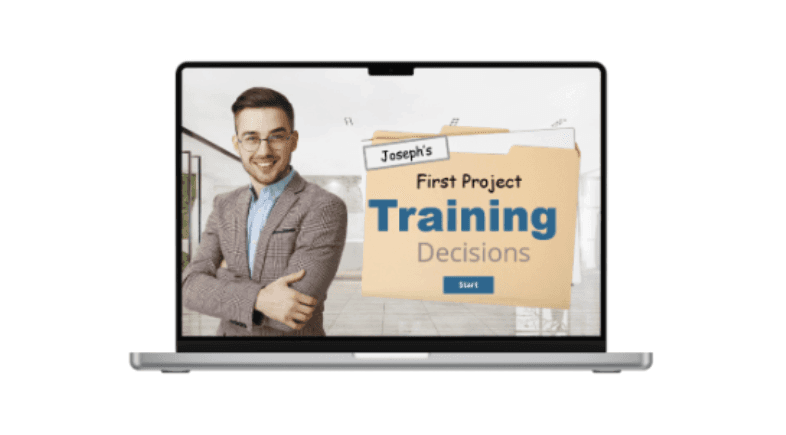
Joseph’s First Project Training Decisions
Joseph’s First Project
Training Decisions
Designed as a scenario-based course, it places learners in Joseph’s shoes, guiding them through the decision-making process of developing job-specific training. From conducting client meetings and gathering information to identifying hazards and designing engaging content, participants make choices that shape Joseph’s success. The project blends storytelling with interactive activities—such as walkthroughs, branching scenarios, and knowledge checks—to immerse learners in real-world challenges. By combining narrative, visuals, and practical decision-making, this course not only introduces Joseph’s journey but also equips learners with the skills to create effective, customer-focused training solutions.
Designed as a scenario-based course, it places learners in Joseph’s shoes, guiding them through the decision-making process of developing job-specific training. From conducting client meetings and gathering information to identifying and designing engaging content, participants make choices that shape Joseph’s success. The project blends storytelling with interactive activities—such as walkthroughs, branching scenarios, and knowledge checks—to immerse learners in real-world challenges. By combining narrative, visuals, and practical decision-making, this course not only introduces Joseph’s journey but also equips learners with the skills to create effective, customer-focused training solutions.
This eLearning experience follows the story of Joseph, a newly hired training specialist, as he takes on his first major project. Designed as a scenario-based course, it places learners in Joseph’s shoes, guiding them through the decision-making process of developing job-specific training. From conducting client meetings and gathering information to identifying hazards and designing engaging content, participants make choices that shape Joseph’s success. The project blends storytelling with interactive activities—such as walkthroughs, branching scenarios, and knowledge checks—to immerse learners in real-world challenges. By combining narrative, visuals, and practical decision-making, this course not only introduces Joseph’s journey but also equips learners with the skills to create effective, customer-focused training solutions.
Audience
New training Specialists
My Role
Instructional design, storyboarding, mockups, prototype, visual design.
Tools Used
Articulate Storyline 360, Freepik, Canva, Google Docs, Chat GPT, Artistly,AI, Artlist.io, Google workplace, and Genially.
The Problem
New training specialists often struggle to develop effective training materials, which has led to repeated customer complaints and forced other trainers to redo their work—resulting in wasted time and resources.
The Solution
To address the problem, I combined my own experience developing job-specific training with insights from transitioning into a new role and feedback from the Training Manager. In my work as a training specialist, I consistently observed challenges among new specialists—including misunderstanding company needs, miscommunication with SMEs, reliance on technical jargon, and the creation of text-heavy presentations with limited visuals or interaction. At times, training was developed without a full understanding of key process details, leading to rework and delays.
These recurring issues motivated me to design a scenario-based eLearning experience that guides new specialists through realistic decision-making. By using a story-driven approach with real-world consequences, the course creates a practical, engaging, and memorable learning environment that encourages the use of best practices from the very beginning of a project.

My Process
I developed this project using the PADDLE in the Pond model, a problem-centered approach that begins with real-world challenges and builds learning activities around solving them. I started by defining the core performance problem. I designed realistic scenarios and decision points that promoted problem-solving and reflection. The storyboard went through several iterations with feedback from the SME and experienced instructional designers, ensuring accuracy, consistency, and a strong learner experience. Once approved, I moved into visual design and media development, producing a supporting video that demonstrated the walkthrough process and highlighted safety hazards in the carwash environment. To build the course, I used various tools, and the final product integrated storytelling and visual cues—guiding learners step by step through the process of creating practical, job-specific training while engaging them with real-world challenges.
My Process
I developed this project using the PADDLE in the Pond model, a problem-centered approach that begins with real-world challenges and builds learning activities around solving them. I started by defining the core performance problem. I designed realistic scenarios and decision points that promoted problem-solving and reflection. The storyboard went through several iterations with feedback from the SME and experienced instructional designers, ensuring accuracy, consistency, and a strong learner experience. Once approved, I moved into visual design and media development, producing a supporting video that demonstrated the walkthrough process and highlighted safety hazards in the carwash environment. To build the course, I used various tools, and the final product integrated storytelling and visual cues—guiding learners step by step through the process of creating practical, job-specific training while engaging them with real-world challenges.
My Process
I developed this project using the PADDLE in the Pond model, a problem-centered approach that begins with real-world challenges and builds learning activities around solving them. I started by defining the core performance problem. I designed realistic scenarios and decision points that promoted problem-solving and reflection. The storyboard went through several iterations with feedback from the SME and experienced instructional designers, ensuring accuracy, consistency, and a strong learner experience. Once approved, I moved into visual design and media development, producing a supporting video that demonstrated the walkthrough process and highlighted safety hazards in the carwash environment. To build the course, I used various tools, and the final product integrated storytelling and visual cues—guiding learners step by step through the process of creating practical, job-specific training while engaging them with real-world challenges.
Result
The feedback I received from peers and experienced instructional designers was overwhelmingly positive. They were impressed by the combination of visual design, engaging interactions, and the course's overall flow. Many highlighted the opening story as a strong element—it clearly demonstrated the consequences of skipping preparation and immediately pulled learners into the narrative. The visuals and storytelling were noted for keeping learners engaged and invested from the start, followed by interactive activities that reinforced decision-making through scenario-based slides. I also received strong feedback on the videos I created using various AI tools, which added depth and realism to the learning experience. Overall, reviewers found that the project effectively reinforced knowledge step by step, blending clear instruction with meaningful practice to create an informative and engaging eLearning solution.

Result
The feedback I received from peers and experienced instructional designers was overwhelmingly positive. They were impressed by the combination of visual design, engaging interactions, and the course's overall flow. Many highlighted the opening story as a strong element—it clearly demonstrated the consequences of skipping preparation and immediately pulled learners into the narrative. The visuals and storytelling were noted for keeping learners engaged and invested from the start, followed by interactive activities that reinforced decision-making through scenario-based slides. I also received strong feedback on the videos I created using various AI tools, which added depth and realism to the learning experience. Overall, reviewers found that the project effectively reinforced knowledge step by step, blending clear instruction with meaningful practice to create an informative and engaging eLearning solution.
Result
The feedback I received from peers and experienced instructional designers was overwhelmingly positive. They were impressed by the combination of visual design, engaging interactions, and the course's overall flow. Many highlighted the opening story as a strong element—it clearly demonstrated the consequences of skipping preparation and immediately pulled learners into the narrative. The visuals and storytelling were noted for keeping learners engaged and invested from the start, followed by interactive activities that reinforced decision-making through scenario-based slides. I also received strong feedback on the videos I created using various AI tools, which added depth and realism to the learning experience. Overall, reviewers found that the project effectively reinforced knowledge step by step, blending clear instruction with meaningful practice to create an informative and engaging eLearning solution.
Action Map
During the analysis phase, I began by identifying the common challenges new training specialists face when stepping into their role. Together with the Training Manager, we decided to focus on the foundational steps a specialist should follow when receiving their first assigned project. We pinpointed the root issue and established the main goal: to reduce errors caused by a lack of preparation and attention to detail, while ensuring the primary focus remains on the client’s needs.
This eLearning experience follows the story of Joseph, a newly hired training specialist, as he takes on his first major project. Designed as a scenario-based course, it places learners in Joseph’s shoes, guiding them through the decision-making process of developing job-specific training. From conducting client meetings and gathering information to identifying hazards and designing engaging content, participants make choices that shape Joseph’s success. The project blends storytelling with interactive activities—such as walkthroughs, branching scenarios, and knowledge checks—to immerse learners in real-world challenges. By combining narrative, visuals, and practical decision-making, this course not only introduces Joseph’s journey but also equips learners with the skills to create effective, customer-focused training solutions.
This eLearning experience follows the story of Joseph, a newly hired training specialist, as he takes on his first major project. Designed as a scenario-based course, it places learners in Joseph’s shoes, guiding them through the decision-making process of developing job-specific training. From conducting client meetings and gathering information to identifying hazards and designing engaging content, participants make choices that shape Joseph’s success. The project blends storytelling with interactive activities—such as walkthroughs, branching scenarios, and knowledge checks—to immerse learners in real-world challenges. By combining narrative, visuals, and practical decision-making, this course not only introduces Joseph’s journey but also equips learners with the skills to create effective, customer-focused training solutions.
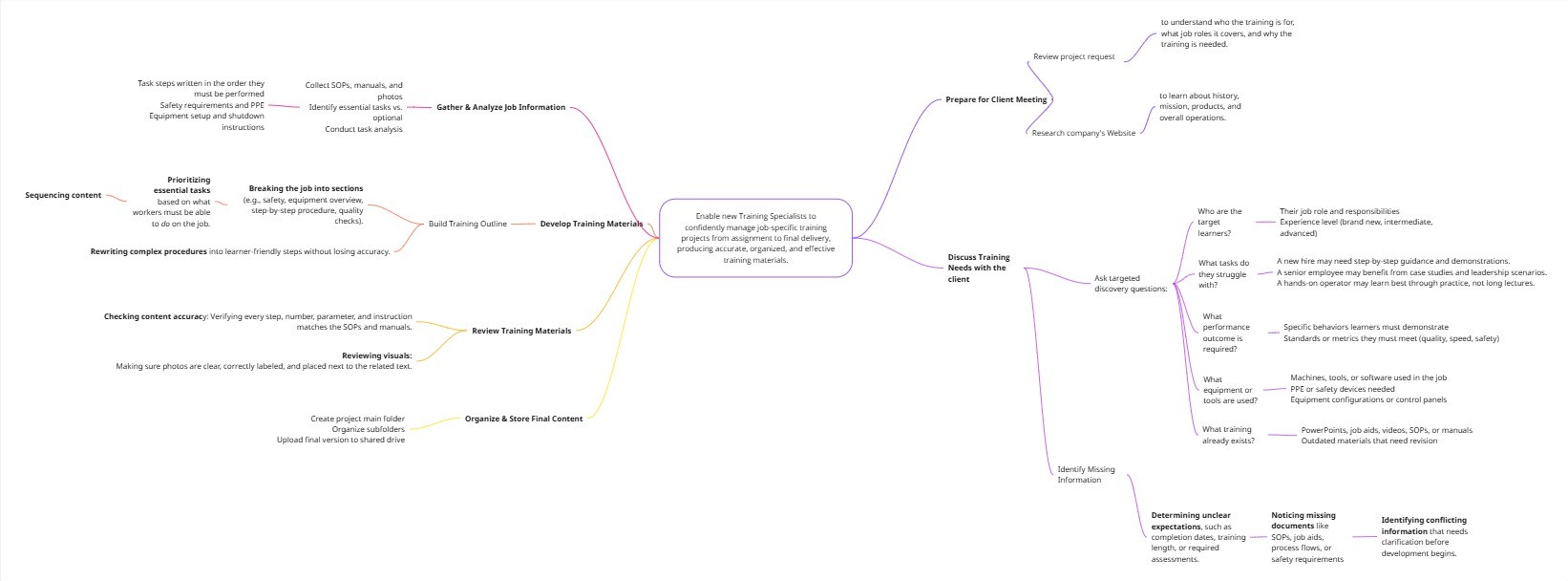
Text-Based Storyboard
After completing the action map, I moved into the design phase and created a text- based storyboard to serve as the project’s blueprint. My goal was to immerse learners in a realistic, scenario-driven experience where they would encounter different client behaviors and choose the best response. Each scenario included one correct option and distractors to encourage reflection on decision-making and its consequences. To mirror real workplace challenges, I introduced Joseph as the new training specialist. His experiences illustrate both effective actions and common missteps, guiding learners through unfamiliar situations. This approach helps learners understand how real decisions impact training outcomes and reinforces the fundamentals of creating effective job-specific training.
This eLearning experience follows the story of Joseph, a newly hired training specialist, as he takes on his first major project. Designed as a scenario-based course, it places learners in Joseph’s shoes, guiding them through the decision-making process of developing job-specific training. From conducting client meetings and gathering information to identifying hazards and designing engaging content, participants make choices that shape Joseph’s success. The project blends storytelling with interactive activities—such as walkthroughs, branching scenarios, and knowledge checks—to immerse learners in real-world challenges. By combining narrative, visuals, and practical decision-making, this course not only introduces Joseph’s journey but also equips learners with the skills to create effective, customer-focused training solutions.
This eLearning experience follows the story of Joseph, a newly hired training specialist, as he takes on his first major project. Designed as a scenario-based course, it places learners in Joseph’s shoes, guiding them through the decision-making process of developing job-specific training. From conducting client meetings and gathering information to identifying hazards and designing engaging content, participants make choices that shape Joseph’s success. The project blends storytelling with interactive activities—such as walkthroughs, branching scenarios, and knowledge checks—to immerse learners in real-world challenges. By combining narrative, visuals, and practical decision-making, this course not only introduces Joseph’s journey but also equips learners with the skills to create effective, customer-focused training solutions.



US Army
Villanova University